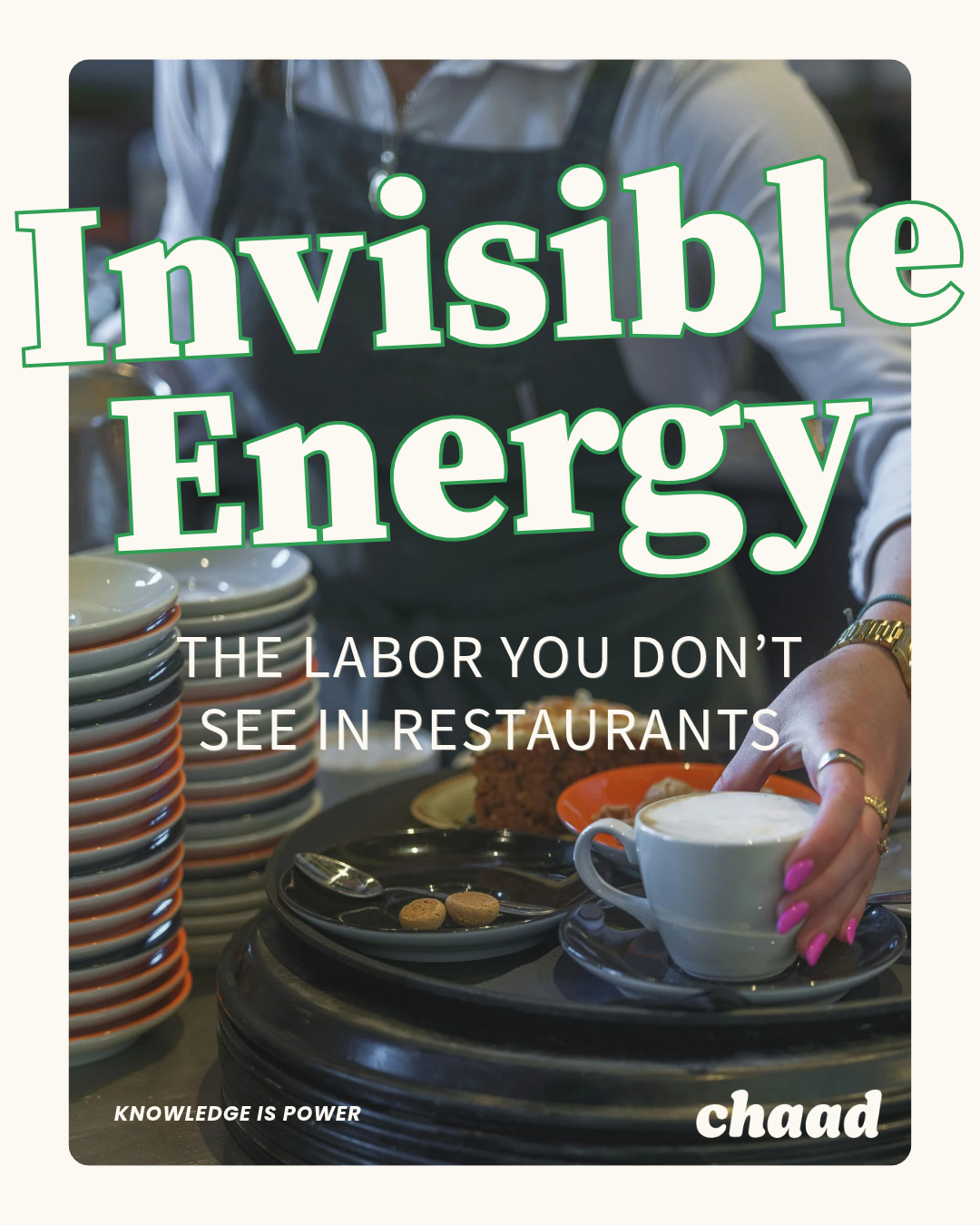
The labor you don’t see in restaurants
Let’s talk about what hospitality actually asks of people
Good hospitality is supposed to look easy. But that ease doesn’t happen by itself. Behind every smooth night is anticipation, problem-solving, emotional regulation, cultural awareness, physical work, and a ton of coordination. Hospitality workers are more than just cooks or servers or hosts; they are professionals skilled at wearing multiple hats within the same shift.
Let’s break down what that looks like.
Emotional Labor
Yours and everyone else's
De-escalation or calming things down: A guest is furious about a long wait. You stay steady, own the delay, and find a fix, even though the delay wasn’t your fault.
Staying kind when others aren’t: You keep smiling and saying “of course!” to a table that’s snapping at you.
Supporting overwhelmed coworkers: You notice the new line cook is in the weeds, so you jump in to support their station and remind them to stay calm.
Parenting other adults: You politely remind a guest not to snap their fingers, or to take the phone call outside, so everyone else can enjoy their meal.
Reading the table: You can tell one table wants a quick, no-fuss meal and the next wants a long chat, and you change your whole energy for each.
Including everyone: You make sure the quiet guest at the end of the table gets a menu explanation and a question too.
Holding big moments: You help set up a proposal, sing happy birthday, or quietly support a table that’s grieving.
Defending prices you didn’t set: A guest asks why there is a service charge on the menu or that an item is overpriced, and you smile through it.
Making space for families: Lids on cups, crayons and paper at the table, and a patient smile when the spill happens anyway.
Intellectual Labor
You’re holding an entire restaurant’s worth of information in your head, ready at a moment’s notice. For example:
Allergies and dietary needs: A guest asks if the sauce is safe for a shellfish allergy. You know what can be swapped, what can’t, and what’s cooked on the same surface.
Knowing how dishes are made: Not just the ingredients, but the method, the spice level, and what it’ll taste like.
Sharing cultural context: You explain where a dish comes from and why it’s prepared the way it is.
Juggling multiple tables: Table 4 is a gluten-free, no-onion order, Table 7 needs their check, and Table 9 is waiting on a modification. You’re tracking all of it at once.
Anticipating needs: You refill the water, bring the extra napkins, and box the leftovers before anyone asks.
Knowing everyone’s job: You know when to stay out of the line, wait for the runner, or protect the bartender’s space.
Explaining policies: You can say why there’s a time limit on the patio or a split-check rule without sounding defensive.
Balancing FOH and BOH: The kitchen is slammed, and the guest is hungry, and you’re the bridge between them.
Physical Labor
What it takes to keep things moving:
Carrying full trays, heavy bus tubs, and cases of product, over and over
Weaving through tight spaces with hot plates and sharp tools
Standing for 8 to 12 hours, often with no real break
Going from a sweltering kitchen to a freezing walk-in to a windy patio in one shift
Making the same motions hundreds of times: pouring, plating, wiping, carrying
Pushing through sore feet, aching backs, and exhaustion because the shift isn’t over
Ignoring the cuts, burns, and blisters that take shape on your body.
Our invisible labor = profit
Why does the invisible labor of restaurant workers matter? Ignoring the vast, multifaceted labor of restaurant workers isn't an accident; it’s an intentional part of a business model sustained by underpaid, overexploited workers.
Checking The Facts
Remember when we were “essential”?
In 2020, restaurant workers were called essential. Society kept running because we showed up, cooked, delivered, and served, often with little protection.
A UCSF study of California death certificates found food and agriculture workers saw a 39% jump in deaths during the pandemic, the largest of any sector, compared with 22% for working adults overall.
Cooks had the highest mortality risk of any occupation in the study, with a risk ratio of 1.60.
The researchers noted that in-person essential workers weren’t protected by shelter-in-place orders.
Essential enough to risk our lives, but not essential enough to protect or pay fairly.
The median wage for food and beverage serving workers was $14.92 an hour in May 2024. That’s about $34,130 a year for the broader food service group, against $49,500 for all occupations.
The federal tipped minimum wage is $2.13 an hour and hasn’t been raised since 1991. It was frozen in 1996 as a concession to the National Restaurant Association’s lobbying.
In states that allow the $2.13 base wage, 18% of waitstaff and bartenders live in poverty, more than twice the rate of non-tipped workers (7%).
Chefs and head cooks have a BLS median around $62,470, while restaurant cooks sit around $37,390. Line cooks earn a fraction of what those who front the brand do.
Fewer protections, more risk
A national ROC United survey of 4,300 restaurant workers found 90% lacked paid sick days and the same share had no employer health insurance.
Nearly 67% of surveyed workers said they’d worked while sick. That’s a health risk for us and for guests.
In that research, 49.5% had been cut on the job, and 45.8% had been burned.
And remember the BLS number from earlier: reported injuries only. If you’re afraid to miss a shift, you may never report it.
Who carries the heaviest load? Invisible labor isn’t distributed evenly
Roughly two-thirds of tipped restaurant workers are women.
Women make up about 7% of the workforce in restaurants, yet restaurants generated 37% of sexual harassment claims filed with the EEOC.
In a ROC survey of 688 restaurant workers, women paid $2.13 an hour reported twice the sexual harassment of women in states that pay the full minimum wage. When your income depends on a guest’s mood, saying “stop” costs you money.
During COVID, Latino food and agriculture workers saw a 59% increase in deaths.
The Costs to our minds
The Burnt Chef Project surveyed 1,273 hospitality workers and found 80% had experienced mental health issues because of their roles. 46% of respondents didn’t feel comfortable talking about their mental health with a friend or colleague.
A 2026 global survey of 460 chefs found 69% routinely consider leaving, citing toxic leadership and unsustainable conditions.
Whose labor gets the credit?
Our industry runs on systems that hide the work of servers, cooks, dishwashers, bussers, and hosts, then hand the praise and profit to a few at the top: owners and celebrity chefs. Those systems lean on gender, race, and class to decide whose work is “skill” and whose is “just part of the job.” Acknowledging everyone’s contribution is necessary if we want to build a better, more equitable industry.
Resources
https://www.theburntchefproject.com/
https://www.southernsmoke.org/
https://www.epi.org/publication/tipped-workers-significantly-states-paid/
https://familyvaluesatwork.org/new-surveys-show-restaurant-workers-must-work-sick-or-lose-pay/
https://znetwork.org/znetarticle/on-the-backs-of-women/